|

Practice
Areas Sales Effectiveness

RMCI customizes each project to meet the unique needs of each client.
We've worked with specialty and primary care sales forces, for large
and medium sized firms, in hospital and clinic based markets, in
countries on every continent.
No two projects are exactly alike. To give you an idea of a 'typical'
pharmaceutical sales force effectiveness project, we've developed
the information below. For specific examples of our work, please
visit our online case studies.
|
|

Results Objectives Process
& Timeline Unique Insights
Findings Analysis
Success Factors
|
|
Increase sales and profits by 5% - 20%

Improve territory balance
Improve first line manager capabilities, especially coaching
Increase access to key customers
Focus marketing resources on most valuable customers
Improve targeting to increase market coverage without increasing
investment
Increase call frequency on key customers
Decrease call frequency on prospect or low value physicians
Improve sales call message impact
|
|

Identify opportunities to increase sales
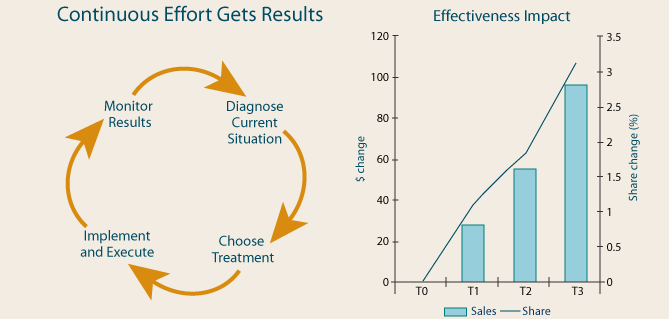
Design the process to continuously track and improve effectiveness
Maximize return on available sales and marketing data
Assess current sales force effectiveness
Identify the key factors that influence selling results
|
|

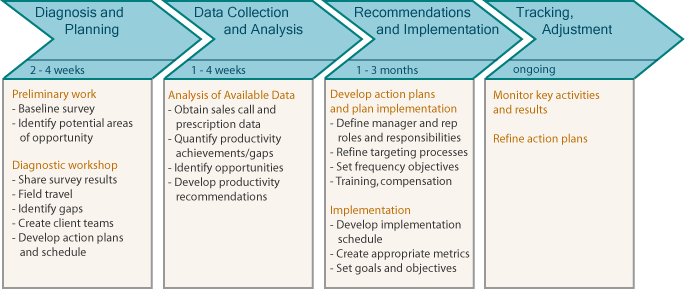
The process and timeline for a sales force effectiveness project
depend on the needs of each individual client. We have conducted
projects of varying sizes and scope -- from focusing on a
single regional sales force to managing improvement efforts
for a project that spanned 30 countries. Project objectives
have ranged from simply assessing the quality of market coverage
to completely re-inventing the sales process.
Below we have outlined a 'typical' 3-month sales force effectiveness
project.
|
|

Our unique process -- involving cross functional teams with
real time field experience -- typically generates insights
that functional managers operating independently would miss.
Often, uncovering these insights and acting on them generates
the most significant sales results. Below, we've listed several
insights that recent clients identified as critical to improving
their sales performance.
District managers’ responsibilities are too narrowly
defined
Training role plays don’t properly prepare reps for
real world selling, e.g. short details
Poor sales and marketing coordination leads to ineffective
program implementation
Available, valuable data is not shared with reps
Compensation systems discourage team selling and best practice
dissemination
Reps resist implementing targeting strategies they don’t
understand or don’t have confidence in
Sales managers focus on tactics and techniques rather than
territory management
|
|

Customer selection (targeting) processes are often poorly
defined, understood, or implemented
Target selection is often based on ease of access or current
sales, not on total market potential
Sales force automation systems are often poorly aligned with
the business process and inhibit effective selling activities
Metrics drive sub-optimal performance -- the calls per day
metric encourages reps to visit easy-to-see rather than high-value
customers
Sales managers are not adequately trained to coach on key
sales drivers such as targeting and territory management
|
|

Sales force effectiveness analysis is a key part of every
sales force effectiveness project. We determine what analysis
to perform based on the unique market conditions faced by
each client and on the availability of results and activity
data. The following analysis from a recent RMCI project with
a U.S.-based top 20 pharmaceutical manufacturer provides an
example of the kind of analysis we might perform for you.
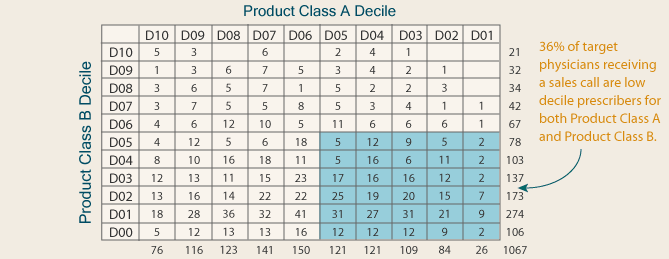
In the following example, RMCI helped to assess the quality
of sales reps’ customer calls for a two-product sales
team. Each customer is ranked according to the volume of sales
within the product class, where D10 indicates the highest
value customers and D01 represents the lowest value customers.
The client was surprised to learn that 36% of customers visited
by sales reps were low value for both product classes. As
a result, the client eliminated calls on low value customers
and increased calls on high value customers.
|
|

Based on our work with hundreds of sales forces worldwide,
we've identified several factors that predict sales effectiveness
success:
Organizational
commitment and buy-in at three levels: sales reps, first line
managers, senior sales and marketing management
Productivity “champion” is a long-term responsibility
Sales managers are trained in coaching skills
Field travel is a top sales manager priority
Management conducts regular reviews and workshops to train
and assess rep and management skills
Managers design, track, and report appropriate metrics
The firm compensates and recognizes productive behavior
|
|
|
|
|